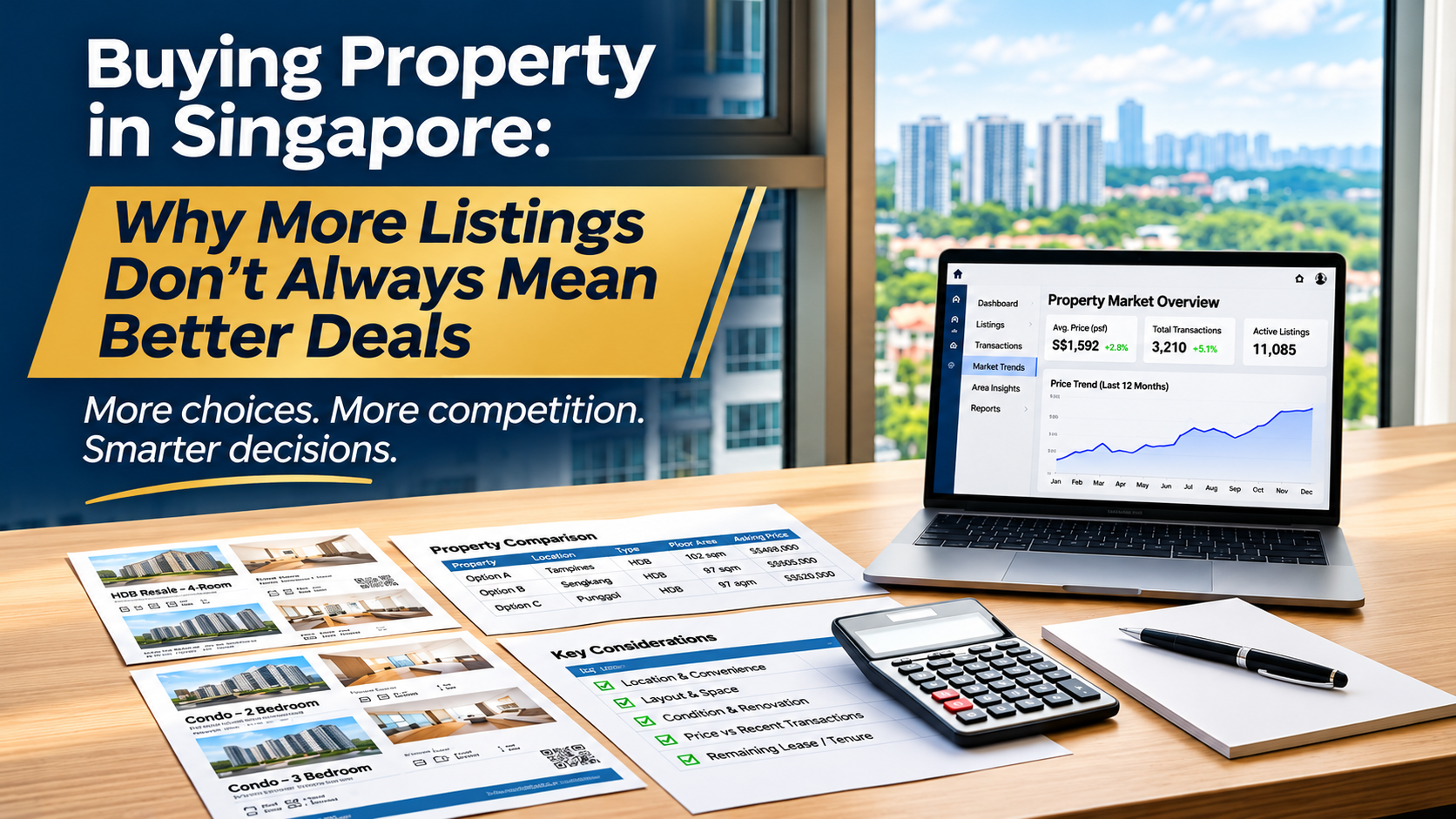
“Isn’t this supposed to be a buyer’s market?”
It’s a question I often hear from people buying property in Singapore.
When there are more properties available, buyers naturally expect lower prices, more choices and greater room for negotiation.
It sounds logical. If sellers have more competition, surely buyers should have the upper hand?
But once they start house hunting, many discover something surprising.
The homes they love are often the same ones other buyers want too.
Having more listings does not necessarily mean finding a suitable property becomes easier. It also does not guarantee that sellers will be willing to lower their prices.
When buying property in Singapore, understanding the difference between market supply and the demand for individual properties can help you make better decisions.
Here are five important considerations I encourage buyers to keep in mind.
1. More Listings Don’t Always Mean More Good Choices
In some HDB estates, particularly where more flats have reached their Minimum Occupation Period (MOP), buyers may find a wider selection of resale listings.
However, not every unit offers the same value or suits the same lifestyle.
When buying property in Singapore, many buyers tend to look for similar features:
- High floors with unblocked views.
- Minimal afternoon sun.
- Practical and spacious layouts.
- Good move-in condition.
- Convenient access to MRT stations and amenities.
- Comfortable living environments with sufficient privacy.
- A suitable remaining lease.
Even when there are many properties available, units offering a desirable combination of these features may continue to attract strong interest.
For example, imagine there are 20 resale flats available in your preferred neighbourhood.
After considering your budget, preferred floor level, layout and distance from the MRT station, you may find that only three genuinely meet your requirements.
Other buyers with similar priorities may also be interested in those same three units.
Suddenly, the market may not feel as favourable as you initially expected.
You can read more about broader market considerations in my article on the HDB Resale Market 2026: 5 Important Insights for Buyers & Sellers.
A market with more supply doesn’t mean every desirable home will be easy to secure.
The important thing is to distinguish between having more listings to browse and having more suitable homes to choose from.
2. What Happens When Multiple Buyers Want the Same Home?
One challenge when buying property in Singapore is managing expectations when several buyers are interested in the same unit.
I recently experienced this while helping a buyer search for her next property.
Several times, we found units she genuinely liked.
But just as we were preparing to make an offer, another interested buyer appeared.
Sometimes, we were asked to submit our highest offer.
Other times, the seller remained firm on the asking price.
Naturally, this was frustrating for a buyer who expected greater negotiating power in a market with more choices.
But it reinforced something important:
A buyer’s market doesn’t mean every seller is willing to negotiate.
Understand the Seller’s Position
Different sellers have different motivations and financial circumstances.
Some may need to sell within a specific timeline because they have already committed to another property or are planning their next housing move.
Others may have the financial flexibility to wait for an offer that meets their expectations.
A seller who is not under significant time pressure may be less willing to negotiate, particularly if their property continues to attract enquiries and viewings.
When buying property in Singapore, understanding the seller’s circumstances, where that information is available, can help you approach negotiations more strategically.
However, buyers should not assume that a seller is under financial or time pressure simply because a property has been listed for some time.
In my earlier article on What Property Buyers and Sellers Fear Most in Singapore, I discussed some of the uncertainty both parties experience when making property decisions.
Sellers may worry about accepting an offer too early, while buyers may worry about paying more than necessary.
Understanding these different perspectives can help both parties approach negotiations with more realistic expectations.
3. How Do You Know When a Property Is Worth Pursuing?
When buying property in Singapore, it is easy to feel pressured when a desirable unit attracts competing offers.
You may worry that taking too long to decide could mean losing the property to another buyer.
But I don’t believe buyers should rush simply because another offer appears.
Instead, I encourage them to consider five important questions:
- Is the asking price reasonable compared with similar transactions?
- Which features make this particular unit stand out?
- Can any shortcomings be improved through renovation?
- What do we actually know about the competing buyer interest?
- What is the maximum price we are comfortable paying?
These questions help buyers distinguish between genuine property value and the pressure of competition.
Compare Asking Prices With Actual Transactions
One of the most useful steps when buying property in Singapore is reviewing comparable transactions before making an offer.
For HDB resale buyers, the HDB Resale Statistics provide information about recorded resale prices across different towns and flat types.
Private property buyers can refer to the URA Private Residential Property Transactions database to review recorded transactions.
These resources can help you understand how similar properties have been priced in the market.
However, comparable transactions should not be your only consideration.
Two units in the same development or HDB block can differ in condition, floor level, orientation, remaining lease and layout.
The objective is not necessarily to secure the lowest possible price.
It is to understand whether the price you are paying is reasonable for the specific property and the benefits it offers.
Understand Which Property Features Can Be Changed
Another important consideration when buying property in Singapore is distinguishing between features you can improve and features that are difficult or impossible to change.
For example, you may be able to update:
- Kitchen cabinets and appliances.
- Interior finishes and colour schemes.
- Flooring and lighting.
- Built-in furniture and storage.
- Certain non-structural layout elements, subject to approval.
However, other features are much harder to change:
- Property location.
- Floor level.
- Unit orientation and facing.
- Structural walls.
- Remaining lease.
- Distance from transport and amenities.
A property that requires renovation may still be worth considering if its location and fundamental features are suitable.
On the other hand, a beautifully renovated home may not be the best choice if its location or layout does not support your lifestyle.
For buyers considering private property, I have also shared additional insights in my article on Condo Resale Potential in Singapore for S$2M–S$3M Buyers.
Understanding what you can and cannot change helps you decide what is genuinely worth paying for.
4. Prepare Your Budget Before Entering Negotiations
Financial preparation is an essential part of buying property in Singapore.
When buyers find a home they genuinely like, emotions can sometimes influence their decisions.
An additional S$10,000 or S$20,000 may appear relatively small compared with the property’s overall purchase price.
But every increase in your offer should be considered alongside your available savings, financing arrangements and future financial commitments.
Before making an offer, I encourage buyers to establish a comfortable purchase budget and a clear maximum price.
Your Maximum Loan Is Not Necessarily Your Maximum Budget
Being eligible for a particular housing loan does not automatically mean you should borrow the maximum amount.
Apart from the purchase price, buyers should consider other expenses such as:
- Stamp duties and applicable fees.
- Legal and administrative costs.
- Renovation and furnishing expenses.
- Monthly mortgage repayments.
- Ongoing maintenance costs.
- Emergency savings.
For HDB buyers, obtaining a valid HDB Flat Eligibility (HFE) letter before receiving an Option to Purchase is an important requirement.
You can refer to the official HDB Flat Eligibility (HFE) letter guide to understand the process.
When buying property in Singapore, having a clear understanding of your financial position can also help you negotiate with greater confidence.
You will be better prepared to decide whether increasing your offer makes financial sense or whether it is time to consider another property.
In my article Planning to Buy a Property? Find Out If You Need an Agent, I discuss some of the considerations buyers may encounter throughout their property purchase journey.
A well-prepared buyer is not necessarily someone who can offer the highest price.
It is someone who understands what they can comfortably afford and makes decisions accordingly.
5. Knowing When to Walk Away Matters Too
Not every property is worth competing for.
Sometimes, another buyer may be willing to offer significantly more than what you consider reasonable.
And that’s okay.
When buying property in Singapore, there may be occasions when you genuinely like a home but cannot justify the seller’s asking price.
This can be disappointing, especially after spending weeks or months searching for a suitable property.
But I believe it is important to remember why you started your property search in the first place.
You are looking for a home that supports your lifestyle, meets your needs and remains within your financial comfort zone.
You are not simply trying to win a negotiation.
Don’t Let the Fear of Missing Out Determine Your Offer
The fear of losing a desirable property can sometimes encourage buyers to make decisions they would not otherwise consider.
However, another buyer’s willingness to pay a higher price does not necessarily mean you should do the same.
Their financial circumstances, priorities and reasons for purchasing may be very different from yours.
If a property no longer fits your budget or the price becomes difficult to justify, walking away can be a sensible decision.
At the same time, if a property genuinely meets your requirements, is reasonably priced and remains within your financial comfort zone, it may be worth making a timely decision.
The key is to act based on preparation and understanding rather than pressure or emotion.
A good property decision isn’t about winning every negotiation. It’s about knowing which opportunities are worth pursuing.
A Practical Checklist Before Buying Property in Singapore
Before submitting an offer, take some time to review the following questions:
- Does the property meet my essential lifestyle requirements?
- Have I reviewed recent comparable transactions?
- Do I understand the property’s strengths and limitations?
- Have I accounted for renovation and other purchasing expenses?
- Is the asking price within my comfortable budget?
- Will the property continue to suit my needs over the next few years?
- Am I making this decision because the property offers genuine value or because I am afraid of missing out?
If you can answer these questions confidently, you may be in a better position to decide whether the property is worth pursuing.
For buyers searching for an HDB resale flat, the official HDB guide to finding a resale flat is also a useful resource for understanding eligibility, financing preparation and property selection.
Final Thoughts: More Listings Don’t Always Mean Better Deals
Buying property in Singapore requires more than simply monitoring listings and waiting for prices to fall.
Even when buyers have a wider selection of properties, well-located homes with practical layouts and desirable features may continue to attract competition.
Some sellers will negotiate. Others may prefer to wait.
Some properties may justify a higher offer because they genuinely meet your needs, while others may not offer enough value at their asking price.
Understanding these differences can help you approach your property search with greater clarity.
To me, the real advantage is not necessarily finding the cheapest property or securing the biggest discount.
It is knowing how to identify the right opportunities, negotiate with confidence and make a decision that supports your long-term goals.
Thinking About Buying Property in Singapore?
House hunting can feel overwhelming when prices, seller expectations and competing offers don’t align.
Whether you are buying your first HDB resale flat, upgrading to a condominium or exploring your next property move, having a clear strategy can help you make more informed decisions.
Let’s explore your budget, preferred locations, lifestyle requirements and long-term plans before deciding which property is right for you.
Connect with me, Iris Ho, for a no-obligation property consultation, and let’s work towards finding a home that suits your needs and financial comfort.



Leave a Reply